
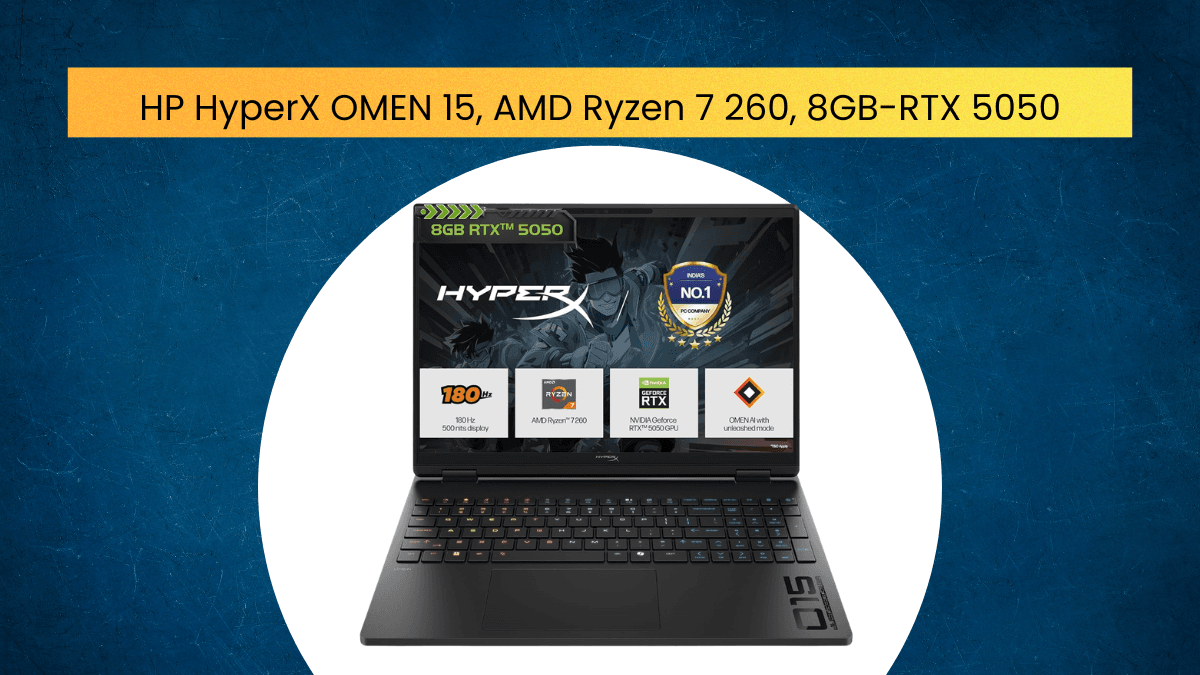
The HP OMEN 15 is a well-engineered gaming laptop that prioritises thermal stability and display quality over raw GPU power. It delivers a genuinely refined daily experience, but at ₹1,37,999 with an RTX 5050, it asks you to pay a premium for polish rather than performance headroom — and that’s a trade-off worth thinking carefully about before buying.
Who This Laptop is For
The OMEN 15 is built for a specific kind of buyer: someone who games seriously but also uses their laptop for work, content consumption, or light creative tasks throughout the day. It’s not chasing benchmark crowns. It’s not loaded with aggressive styling or unnecessary RGB theatrics. What it offers instead is a machine that runs cool, looks clean, and holds up under hours of continuous use without becoming a liability.
If you want maximum GPU performance per rupee, this is not that laptop. If you want a gaming machine that also functions as a reliable daily driver without thermal complaints or fan noise anxiety, the OMEN 15 makes a strong case for itself.
Specifications at a Glance
| Component | Specification |
|---|---|
| Display | 15.3-inch 2.5K IPS, 2560×1600 |
| Refresh Rate | 180Hz |
| Processor | Intel Core i7-14650HX |
| GPU | NVIDIA RTX 5050 Laptop GPU |
| RAM | 24GB DDR5 5600 MT/s |
| Storage | 1TB PCIe Gen4 SSD |
| Weight | 2.21kg / 2.36cm thin |
| Connectivity | Wi-Fi 6, Bluetooth 5.4 |
Design and Build Quality — 4/5
HP has resisted the temptation to make the OMEN 15 look aggressive. The matte-black chassis is clean enough to take into a professional setting without drawing unwanted attention, which is a genuine achievement in a category full of angular plastic and excessive branding. The refreshed HyperX-influenced design touches — subtle logo placement, clean lines — add personality without tipping into gamer-aesthetic excess.
At 2.21kg, it sits in the middle of the gaming laptop weight spectrum. Not something you’d forget you’re carrying, but manageable for campus or café use. Build quality is solid throughout: the hinge holds firmly under single-hand opening, keyboard flex is minimal, and the polycarbonate chassis feels more premium than its material suggests.
The one cosmetic complaint is real: the matte coating is a fingerprint magnet. Within an hour of use, the palm rest and lid show smudges clearly. A microfibre cloth becomes a necessary accessory.
Port selection: two USB-A, one USB-C with DisplayPort, HDMI 2.1, RJ-45 Ethernet, and a 3.5mm audio jack. Functional for most setups, but anyone running dual monitors or a streaming rig will want a hub.
Gaming vs. Editing Laptop: Which One is Better? (2026 Buying Guide)
Display — 4/5
The 2.5K panel is the OMEN 15’s most immediately impressive feature, and it earns that impression over extended use.
Moving from 1080p to 2560×1600 is most noticeable not in games — where the difference at typical viewing distances is subtle — but in everyday tasks. Text is sharper, browser reading is more comfortable, and spreadsheets or code editors genuinely benefit from the extra vertical height that the 16:10 aspect ratio provides. It’s a display that makes the laptop better at work, not just gaming.
For gaming specifically, the 180Hz refresh rate with VRR support makes fast-paced titles feel extremely responsive. Competitive players in Valorant or CS2 will appreciate the smoothness, and the 3ms response time means ghosting isn’t a concern. Colour coverage at 100% sRGB is solid for photo editing or video colour work, though it won’t satisfy professional colour-grading demands. The 500-nit brightness handles most indoor environments confidently, and the anti-glare coating does useful work near windows.
CPU Performance — 4.5/5
The Intel Core i7-14650HX is a strong performer, and in this laptop it’s given enough thermal headroom to actually use that performance.
Benchmark results:
| Test | Score |
|---|---|
| Cinebench 2026 Multi-Core | 1,636 |
| Cinebench Single-Core | 383 |
| Geekbench 6 Single-Core | 2,421 |
| Geekbench 6 Multi-Core | 12,629 |
These numbers are competitive for an HX-class processor, but the more important story is sustained performance. HX-series chips are known for running hot and throttling under extended loads in poorly cooled laptops. The OMEN 15 avoids that problem. After 30 minutes of continuous Cinebench looping, scores dropped by less than 4% — a result that reflects genuine thermal engineering rather than spec-sheet optimism.
For multitasking, video editing, and running productivity software alongside gaming, the 24GB DDR5 and fast NVMe SSD keep everything feeling responsive.
GPU Performance and Gaming — 4/5
This is the section that requires the most nuance.
The RTX 5050 is not a flagship GPU. At ₹1,37,999, that’s a legitimate concern, and buyers comparing spec sheets to RTX 5060-equipped competitors in a similar price bracket will find the numbers favour those alternatives on paper.
In practice, the gap is narrower than expected — and the reason is DLSS 4.5 with Multi-Frame Generation. NVIDIA’s latest upscaling and frame generation technology allows the 5050 to punch noticeably above its raw rasterisation performance. In supported titles, the difference between DLSS on and off is large enough to meaningfully change the gaming experience.
Gaming performance at 1080p:
| Game | Frame Rate |
|---|---|
| Forza Horizon 5 | ~170 FPS |
| COD: Black Ops 7 | ~135 FPS |
| Battlefield VI | ~90 FPS |
| Doom: The Dark Ages | ~170 FPS (DLSS on) |
| Marvel Rivals | 105–130 FPS |
Synthetic benchmarks:
| Test | Score |
|---|---|
| 3DMark Time Spy | 9,877 |
| 3DMark Fire Strike | 25,648 |
| Geekbench OpenCL | 94,351 |
Frame pacing is stable and consistent — no sudden drops or stutters during extended sessions. Ray tracing is serviceable but not the 5050’s strength; DLSS carries most of the heavy lifting there.
The honest verdict: if your primary concern is raw GPU performance, look at RTX 5060 alternatives. If you’re buying into a complete, well-tuned system where the GPU is one component among several, the OMEN 15 holds its own better than raw specs suggest.
Cooling and Thermals — 4.5/5
This is where the OMEN 15 earns its premium positioning most clearly.
HX-series Intel processors are thermally demanding by design — they’re meant to run hot and fast. Many gaming laptops manage this by simply letting temperatures climb until the chip throttles itself back. HP’s approach here is different. The cooling system is tuned to keep the CPU below 75°C and the GPU below 70°C during sustained gaming, and testing confirmed those numbers hold through multi-hour sessions.
The practical benefit is real: when a gaming laptop doesn’t throttle, performance during hour three of a gaming session is the same as during minute one. That consistency matters more for actual gaming enjoyment than peak benchmark scores.
HP also includes an automated fan-cleaning mode that pulses the fans to clear dust buildup — a small but genuinely useful feature for long-term maintenance. Fan noise under load is present but not distracting.
Battery Life — 2/5
There’s no softening this one. Battery life is average for a gaming laptop and significantly below what productivity-focused machines in a similar price range offer.
In a conservative mixed-use profile — Eco mode enabled, integrated graphics active, brightness at 50% — expect 3.5 to 4.5 hours. Real-world campus or café use with a browser, notes app, and occasional video will land toward the lower end of that range.
Gaming on battery is effectively not a use case here, as it is with most gaming laptops.
Fast charging is a genuine saving grace: roughly 30 minutes to reach 50%, and about 1 hour 40 minutes for a full charge from empty. If you’re near a socket for most of the day, the battery situation is manageable. If you need all-day unplugged endurance, this isn’t the machine.
Audio and Webcam — 4/5
The downward-firing speakers produce clean audio at moderate volumes but run out of headroom at maximum output — they’re fine for background music and YouTube, not ideal for filling a room. DTS Sound Unbound improves the spatial presentation meaningfully through headphones, which is likely how most users will listen anyway.
The 1080p IR webcam is a genuine high point for a gaming laptop. Windows Hello face unlock works quickly and reliably, HDR auto-adjustment handles backlit environments better than most laptop cameras, and the dual-array microphones with temporal noise reduction produce cleaner voice quality than the speakers might lead you to expect.
Value Assessment — 3.5/5
At ₹1,37,999, the OMEN 15 is priced at the upper edge of where an RTX 5050 laptop can justify itself. The competition is real: RTX 5060 laptops are available in this bracket or only marginally above it, and on raw GPU benchmarks they will outperform the 5050.
What you’re paying for with the OMEN 15 is a level of system integration and thermal engineering that cheaper or more spec-aggressive alternatives don’t always deliver. The cooling headroom, display quality, keyboard comfort, and sustained performance stability are genuine differentiators — they just require you to value those things over GPU model numbers.
For buyers who game heavily for long sessions, use the same laptop for work, and want a machine that feels premium without gaming-laptop styling excess, the premium is defensible. For buyers who prioritise GPU performance above all else, the maths doesn’t work as well.
Final Verdict
Overall Rating: 4/5
The HP OMEN 15 is a thoughtfully engineered gaming laptop that rewards daily use in ways that benchmark comparisons don’t fully capture. Its cooling system is legitimately excellent, its display is one of the better panels in the gaming laptop category, and its sustained performance holds up in a way that many competitors don’t.
The RTX 5050 at this price point is the real conversation, and it’s fair to push back on it. But if you’re buying a laptop for the full experience rather than a single spec line, the OMEN 15 makes a genuine argument for itself.
Buy it if: You want a refined, well-cooled gaming laptop that doubles as a comfortable daily machine and value long-term reliability.
Skip it if: Maximum GPU performance per rupee is your priority — there are stronger options in this price range on that specific metric.
Frequently Asked Questions
Is the HP OMEN 15 good for gaming?
Yes, particularly for esports titles and mid-to-high settings in AAA games. DLSS 4.5 with Multi-Frame Generation gives the RTX 5050 more headroom than its tier suggests, and the 180Hz display makes fast-paced gaming feel genuinely smooth.
How does the RTX 5050 hold up against newer GPUs?
It’s a mid-range GPU that benefits significantly from DLSS optimisation. In raw rasterisation, RTX 5060 laptops outperform it, but in DLSS-supported titles, the gap narrows considerably.
Is this laptop good for video editing?
Yes. The i7-14650HX, 24GB DDR5, and PCIe Gen4 SSD handle most editing workloads comfortably, including 4K timelines in DaVinci Resolve and Premiere Pro.
What is the battery life like in real use?
Expect 3.5 to 4 hours of genuine mixed use. Fast charging (50% in ~30 minutes) helps compensate, but this isn’t a laptop for all-day unplugged work.
How does the OMEN 15 compare to Lenovo Legion alternatives?
The OMEN 15 prioritises thermal stability and display quality; Legion laptops in this range often offer stronger GPU specs for the price. The right choice depends on whether you value system polish or raw performance headroom more.