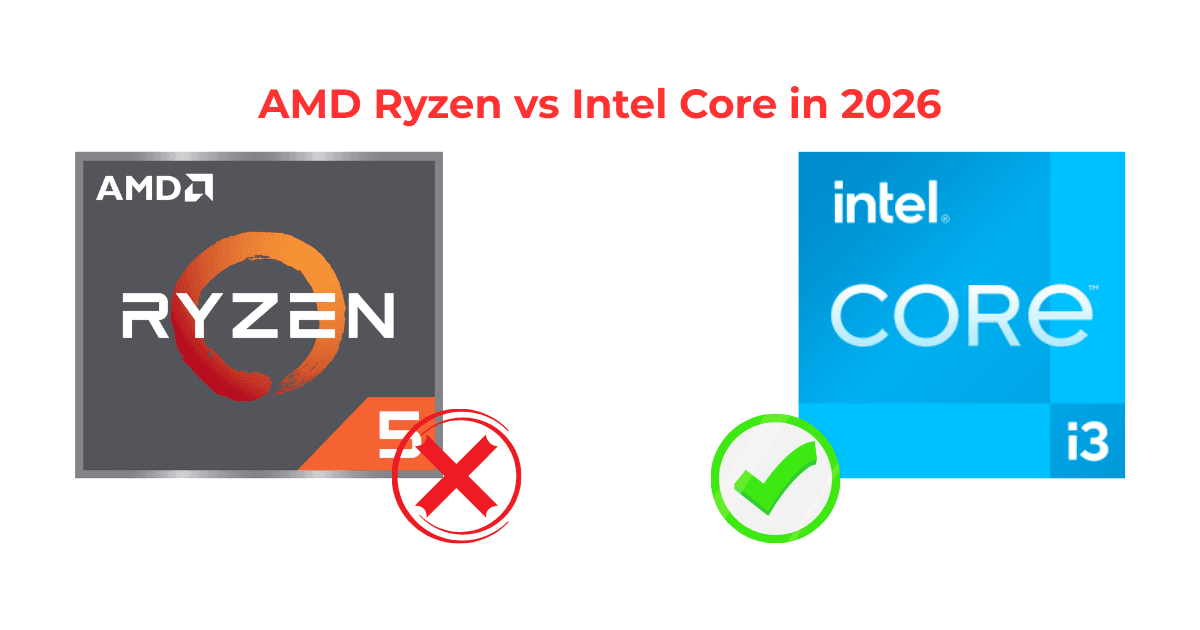
If you’ve spent any time researching CPUs lately, you already know the frustration. Open five comparison articles, and you’ll get five different answers, most of them vague, most of them outdated. The truth is that in 2026, choosing between AMD Ryzen and Intel Core is less about brand loyalty and more about matching the right chip to what you actually do with your computer.
This guide cuts through the marketing noise. Whether you’re building a gaming rig, buying a new laptop for college, editing videos professionally, or just replacing an aging office machine, here’s what genuinely matters.
Table of Contents
How the Competition Has Shifted in 2026
Three years ago, the AMD vs Intel debate had cleaner battle lines. AMD dominated efficiency and value; Intel dominated single-core speed and gaming. Today, both companies have closed most of those gaps, which is great for buyers but genuinely confusing when you’re trying to make a decision.
What has changed most dramatically:
AMD’s X3D technology rewrote gaming performance. By stacking extra cache memory directly onto the processor die, AMD’s 3D V-Cache chips deliver gaming performance that wasn’t possible at any price just a few years ago. The Ryzen 7 7800X3D and its successors consistently top gaming benchmarks in demanding AAA titles.
Intel doubled down on AI and software optimization. Intel’s Core Ultra line introduced dedicated Neural Processing Units (NPUs) and leaned heavily into Microsoft’s Copilot+ ecosystem. If your workflow involves AI-assisted tools — whether that’s video upscaling, real-time transcription, or creative software — Intel’s software partnerships give it a practical edge today.
Laptop efficiency is no longer Intel’s weakness. For years, AMD laptops had a clear battery-life advantage. Intel has closed that gap significantly with its latest efficiency cores architecture, though AMD still holds a slight edge in most real-world battery tests.
Gaming Performance: The Honest Breakdown
Gaming benchmarks are the most misrepresented category in CPU comparisons, so let’s be precise.
Where AMD Ryzen X3D Wins
AMD’s X3D processors genuinely lead in most AAA gaming scenarios, particularly at 1080p and 1440,p where the CPU can become a bottleneck. Games that are heavily dependent on fast cache access — which includes most modern open-world titles — show the largest gaps. If you’re playing titles like Cyberpunk 2077, Hogwarts Legacy, or any CPU-intensive simulator, an X3D chip will deliver noticeably smoother frametimes, not just higher average FPS.
The thermal and power efficiency of X3D chips is also worth noting. They often achieve top-tier gaming performance while running cooler and drawing less power than Intel’s competing high-end desktop chips.
Where Intel Still Competes
Esports titles are a different story. Games like CS2, Valorant, Rainbow Six Siege, and Fortnite are optimized to take advantage of Intel’s strong single-core performance and benefit from Intel’s long history of software-level tuning. If you play primarily at very high refresh rates — 240Hz or above — in competitive titles, the difference can be meaningful.
Intel is also the better choice if you’re pairing your CPU with a mid-range GPU. The X3D advantage shrinks significantly once your GPU becomes the primary bottleneck, which happens earlier in the performance stack than most buyers realize.
The Practical Verdict for Gamers
For most gamers in India, buying a mid-to-high range desktop with a Ryzen X3D processor offers the best gaming performance per rupee available. For pure competitive esports on a tighter budget, an Intel Core i5 remains a genuinely excellent value.
Productivity and Content Creation
Multi-core performance is what determines how quickly your system handles video exports, 3D renders, software compilation, and heavy multitasking. This is where AMD’s core-count advantage translates directly into saved time.
A Ryzen 9 processor will outpace a similarly priced Intel chip in most rendering benchmarks simply because it packs more cores operating at strong sustained frequencies. For creators working in DaVinci Resolve, Blender, or Premiere Pro with heavy timelines, that difference compounds over a full workday.
However, Intel’s advantage in Adobe-specific workflows is real, not marketing. Adobe’s software has been deeply optimized for Intel architectures over many years, and certain operations in Photoshop and After Effects still run faster on Intel chips even when core counts favor AMD. If Adobe products are your primary tools, benchmark your specific workflow before assuming AMD will be faster.
For programmers and developers, either platform performs excellently. The more meaningful choice is often RAM capacity and SSD speed rather than CPU brand.
Laptops: Ryzen vs Intel in 2026
The laptop market is where the competition is most interesting for everyday buyers.
AMD Ryzen Laptops
Ryzen-powered laptops continue to offer strong value in the mid-range segment. Battery life remains slightly better on average, integrated graphics performance is significantly better on Ryzen APU models, and the price-to-performance ratio is difficult to beat in the ₹50,000–₹90,000 range.
Students and remote workers who prioritize battery life, light gaming capability without a dedicated GPU, and reliable performance for everyday tasks will find Ryzen laptops consistently satisfying.
Intel Core Ultra Laptops
Intel’s Core Ultra processors power most of the premium thin-and-light segment in 2026. If you’re buying a high-end ultrabook — the kind with a premium display, Thunderbolt 4 connectivity, and a chassis built to last — there’s a good chance it runs Intel. The ecosystem of accessories, docking stations, and external GPU options built around Thunderbolt remains more mature on Intel platforms.
Core Ultra also delivers genuinely useful AI features for users who rely on Windows-integrated tools. AI-powered noise cancellation, real-time background removal in video calls, and intelligent battery management all work better on Copilot+ certified Intel machines than on equivalent AMD systems today.
Integrated Graphics: AMD’s Clear Advantage
If you’re buying a budget laptop or a desktop without a dedicated graphics card, integrated graphics performance matters more than most spec sheets suggest.
AMD Radeon integrated graphics — particularly in the Ryzen 7000 and 8000 APU series — can comfortably run esports titles at playable framerates without any dedicated GPU. Valorant, Minecraft, GTA V, and similar games run acceptably well on Ryzen integrated graphics in a way that simply isn’t possible on equivalent Intel UHD solutions.
Intel’s Arc integrated graphics in newer Core Ultra chips have improved substantially compared to older Intel HD and Iris Xe graphics, but AMD still leads in gaming-focused integrated performance. For budget buyers who want light gaming capability, this makes Ryzen the practical choice.
Platform Longevity and Upgrades
This is a practical consideration that rarely gets enough attention.
AMD has historically supported its AM4 and AM5 motherboard platforms across multiple CPU generations. That means a motherboard you buy today may accept AMD processors two or three generations from now, spreading your upgrade cost over time.
Intel changes its socket platform more frequently. A motherboard bought for a 12th-gen Intel chip may not support 14th-gen processors, requiring a full platform replacement when you upgrade. For long-term PC builders working within a budget, this is a legitimate reason to prefer the AMD ecosystem.
Who Should Buy What: A Practical Guide
| Your Situation | Best Choice |
|---|---|
| AAA gaming desktop build | Ryzen X3D |
| Competitive esports at 240Hz+ | Intel Core i7 or i9 |
| Budget gaming desktop (under ₹30k CPU budget) | Ryzen 5 |
| Video editing and rendering | Ryzen 7 or Ryzen 9 |
| Adobe Creative Suite power user | Test both; Intel may edge out |
| Student laptop with light gaming | Ryzen mid-range laptop |
| Premium ultrabook for professionals | Intel Core Ultra |
| AI productivity tools (Copilot+) | Intel Core Ultra |
| Budget laptop without dedicated GPU | Ryzen APU |
| Long-term upgradeable desktop build | AMD platform (AM5) |
The Bottom Line
Neither AMD Ryzen nor Intel Core is the universally better processor in 2026. What’s true is that AMD leads in gaming value, multi-core efficiency, integrated graphics, and platform longevity. Intel leads in software ecosystem maturity, premium laptop hardware, AI feature integration, and esports-oriented single-core performance.
The more useful question isn’t which brand is better — it’s which chip is right for your specific use case and budget. A ₹25,000 Ryzen 5 in a well-cooled system with a fast SSD will serve most users better than an overpriced Intel flagship in a thermally throttled laptop.
Buy for your workload. Ignore the brand wars.
Frequently Asked Questions
Is AMD Ryzen better than Intel for gaming in 2026?
For most gaming scenarios, especially AAA titles and 1440p gaming, AMD’s Ryzen X3D processors currently offer the strongest performance. Intel remains competitive in esports titles and high-refresh-rate gaming.
Which is better for laptop buyers in India?
Ryzen laptops offer better value and battery life in the mid-range segment. Intel Core Ultra laptops dominate the premium thin-and-light category and offer stronger AI feature support.
Can a Ryzen processor handle video editing professionally?
Yes. Ryzen 7 and Ryzen 9 processors are well-suited to video editing, 3D rendering, and streaming workloads. Adobe-heavy workflows may still favour Intel on specific operations.
How long will an AMD or Intel platform last?
Both processors last many years with proper cooling. AMD’s platform advantage is in motherboard compatibility — AM5 boards are expected to support future Ryzen generations, making upgrades more affordable over time.